


Key Takeaways
- Skating skills are the foundation of every discipline in figure skating. Strong edges, turns, and control shape both technical consistency and artistry.
- Yuka Sato emphasizes fundamentals: they prevent injuries, extend careers, and form the base for every jump, spin, and movement.
- Edges and turns matter most. They’re the “handwriting” of a skater — deep edges and clean turns make programs look effortless, while shallow ones make them look labored.
- Speed with control is key. Judges reward skaters who look powerful and polished, not those who race across the ice without precision.
- Alignment builds confidence. Good posture and core stability create balance under pressure and lead to steadier landings and smoother transitions.
- Off-ice training fuels progress. Strength, flexibility, balance, and cardio all support better on-ice performance — along with mental rehearsal.
- Transitions showcase mastery. The difference between skaters with strong fundamentals and those without is unmistakable, especially in step sequences and connecting moves.
- Musicality transforms skating into performance. Strong basics give skaters freedom and fluidity to express the music with artistry.
- Time on the ice is irreplaceable. More consistent, focused practice builds comfort, muscle memory, and long-term confidence.
- Visualization sharpens the mental game. Mentally skating programs builds confidence and consistency when it matters most.
- The right coach makes all the difference. Great coaches prioritize fundamentals, provide guidance, and nurture resilience.
- Ice dance strengthens fundamentals. Even freestyle skaters benefit from dance training, which refines edges, posture, rhythm, and artistry.
Bottom line: Fundamentals aren’t just the first step in figure skating—they’re the secret ingredient that carries athletes to long-term success, artistry, and unforgettable performances.
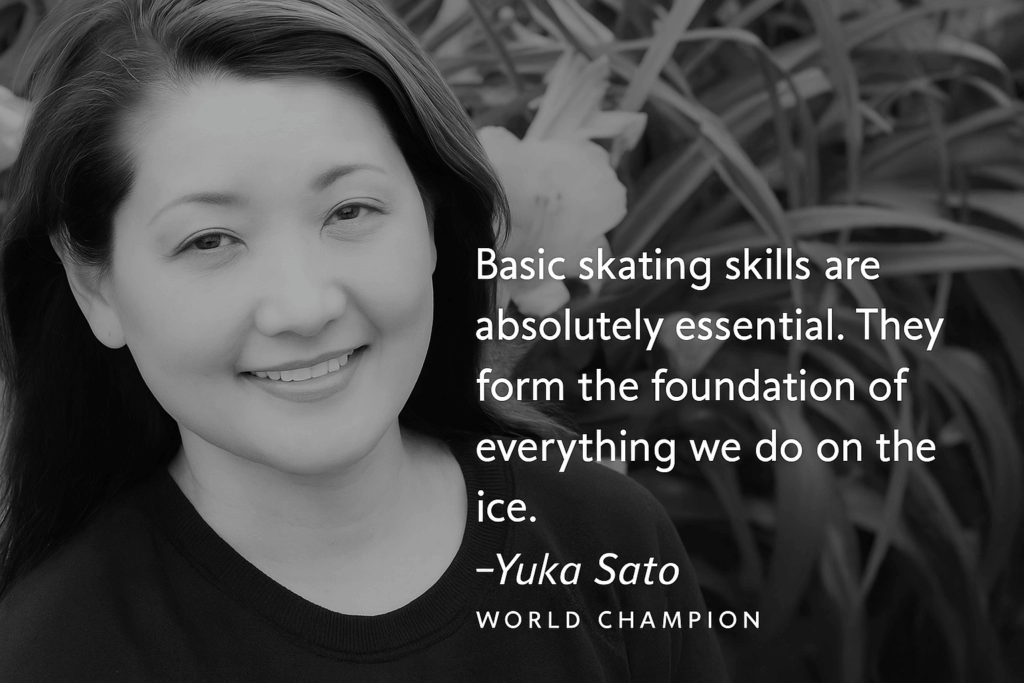
Skating skills are the foundation of success in figure skating, regardless of discipline. They influence a skater’s ability to execute every aspect of their program, from the intricacies of jumps and spins to the flow of step sequences and musical interpretation. In competitive scoring, skating skills are a key component of the Program Components Score (PCS), reflecting a skater’s edge quality, speed, flow, control, and overall command of the ice.
As World Champion, 2-time Olympian, and renowned coach, Yuka Sato emphasizes:
“Basic skating skills are absolutely essential. They form the foundation of everything we do on the ice. Not only do they prevent injuries, but they also allow a skater to build a long-lasting career. These fundamentals create the base from which every jump, spin, and movement emerges—often in ways we don’t fully appreciate until later.”
Even without jumps, superior skating skills can outscore performance ability alone, as they demonstrate mastery over the technical demands of the sport. They also unlock artistry, helping skaters move with grace and confidence.
Below are 10 ways skaters can deliberately develop and strengthen their skating skills — each rooted in fundamentals and elevated by artistry.
Table of Contents
Why Are Skating Skills So Crucial?
Control of the blades affects everything a skater does on the ice. In ice dance, where jumps are not a factor, the ability to carve deep edges and maintain seamless transitions is paramount. Even in freestyle skating, where jumps often steal the spotlight, strong skating skills enable skaters to approach their elements with speed, confidence, and precision. Without well-developed skating skills, a skater will struggle to maintain competitive technical scores or execute difficult elements effectively.
Sato explains that the difference is instantly recognizable:
“When an athlete has strong basics, you can feel and see it on the ice. The difference between a skater with solid fundamentals and one without is always unmistakable.”
Skating skills also bridge the gap between talent and artistry. A skater who moves effortlessly across the ice conveys a sense of grace and fluidity that elevates their performance, regardless of their body type or athleticism.
How Skating Skills Affect Scores
In figure skating competitions, Skating Skills is one of the five components of the PCS, along with Performance, Choreography, Interpretation, and Transitions. Judges evaluate edge quality, speed, ice coverage, and the ability to perform elements with fluidity and control.
Sato highlights why this matters under pressure:
“It gives us a sense of control which is an essential component to successful and consistent performance under pressure.”
A skater with deep edges and seamless transitions will almost always outscore one with shallow edges and clunky movements, even if both perform similar technical elements.
How Skaters Can Develop and Improve Skating Skills
Improving skating skills requires deliberate practice, attention to detail, and a commitment to building strong fundamentals. Below are 10 expanded tips, each with a 300+ word explanation, to help skaters enhance their skating skills.
1. Focus on Edges and Turns
If jumps are the fireworks of figure skating, edges and turns are the wiring that makes the whole show possible. Before anyone lands their first double axel or attempts a flying spin, they have to master something much less glamorous: how to bend their knees, shift their weight, and feel the blade carve into the ice.
Strong edges are like a skater’s “handwriting.” Deep, controlled edges flow across the ice like elegant cursive, while shallow ones look clunky and awkward. This is why coaches drill figure eights, rockers, counters, and brackets until they’re second nature. They aren’t busywork — they’re the foundation that makes everything else look effortless.
Edges affect artistry just as much as technique. A step sequence carved with confidence has flow and breath, while shallow edges look rushed and flat. The difference isn’t just visible; it’s felt. As Yuka Sato reminds us, strong basics form the base for everything — often in ways skaters don’t fully realize until later in their careers.
The secret? Slow down. Don’t rush through edge drills just to “check the box.” Pay attention to where your weight is, how deep your edge feels, and whether your posture is stacked. Over time, edges and turns become the quiet power behind every jump, spin, and movement.
2. Work on Speed and Power
One of the first things people notice about great skaters isn’t just their jumps — it’s how they move. A strong skater can fly across the rink in just a few strokes, covering the ice with effortless speed. That kind of power makes every jump higher, every spin more dynamic, and every performance more exciting to watch.
But real speed isn’t about charging around. It’s about gliding fast while still looking calm and in control. Skaters achieve this by using technique — deep knees, clean crossovers, and powerful pushes — not just raw muscle. That’s why coaches rely on stroking drills, power pulls, and crossover exercises.
Off-ice training matters here too. Plyometrics, sprint drills, and strength workouts build the explosive push skaters need. As Yuka Sato observes:
“When an athlete has strong basics, you can feel and see it on the ice.”
That “feel” often shows up in speed. The best skaters don’t just look fast — they look easy. Their power flows, rather than forcing its way across the ice.
3. Perfect Body Alignment
Alignment is about stacking the body so it works as one. When your head, shoulders, hips, and knees are in line, everything feels stable. When they’re off — even by a little — turns wobble, landings get shaky, and spins drift.
Good alignment starts with the core. Pilates, yoga, and balance drills teach skaters to stay upright and steady under pressure. On the ice, alignment is visible in everything: a clean landing with the shoulders square, a spin centered on the spot, or a step sequence where the body looks balanced instead of tilted.
Yuka Sato connects alignment directly to consistency:
“It gives us a sense of control which is an essential component to successful and consistent performance under pressure.”
That control is what allows a skater to deliver when it matters most — not just in practice, but in competition. Under bright lights, with judges watching, alignment becomes a safety net. It keeps the body steady when nerves could otherwise throw everything off.
Improving alignment isn’t about big, dramatic changes. It’s about small, mindful adjustments: keeping the shoulders relaxed instead of hunched, centering the head instead of craning it forward, or checking that the hips aren’t twisting during turns. Skaters who film themselves in slow motion often notice things they never feel in the moment.
In the end, perfect alignment gives skaters two priceless gifts: consistency and freedom. Consistency to deliver under pressure, and freedom to skate with flow instead of fighting against their own body. Once alignment clicks, skating stops feeling like a struggle and starts feeling — finally — like flying.
4. Incorporate Off-Ice Training
Most people think of figure skating as something that happens only on the ice. But the truth is, a huge part of becoming a better skater happens when the skates come off. Off-ice training builds the strength, flexibility, and balance that directly translate into smoother skating, higher jumps, and stronger landings.
Think of off-ice work as building the engine that powers everything on the ice. Squats, lunges, calf raises, and core work create the muscle strength skaters need to push harder and jump higher. Plyometric exercises — like jump squats or box jumps — mimic the explosive power of a takeoff. The stronger the legs and core, the easier it is to generate speed and maintain control.
Flexibility is another big piece of the puzzle. Skaters with good flexibility don’t just look more elegant — they’re also less likely to get injured. Stretching, yoga, or mobility drills improve extension in spirals and spins, while also protecting muscles and joints from the wear and tear of daily practice.
Balance training is equally important. Wobble boards, BOSU balls, or even practicing one-legged poses at home can sharpen the same stabilizer muscles skaters rely on when holding an edge or checking a landing. These small muscles often get overlooked, but they’re the difference between a wobbly edge and one that feels secure and confident.
Off-ice work also includes stamina. Programs run close to four minutes at the senior level, and skating full-out requires endurance. Running, cycling, or swimming builds the cardiovascular base that allows skaters to get through their routines without looking exhausted halfway through.
And let’s not forget the mental side. Visualization is a powerful off-ice tool: closing your eyes and rehearsing jumps, spins, or even entire programs helps build confidence and reinforce muscle memory. Elite skaters often say that if you can perform it in your mind with detail and precision, you’re far more likely to perform it cleanly on the ice.
The best skaters don’t separate “on-ice” and “off-ice” work — they see them as partners. Strength, flexibility, balance, stamina, and mindset all come together to support better skating skills. When a skater takes off-ice training seriously, it shows. They move with more power, skate with more confidence, and recover faster from mistakes.
5. Practice Transitions
Transitions are like the hidden gems of a skating program. They’re not as flashy as a triple jump or a flying spin, but they’re what make a program feel seamless. Without them, routines can look like a series of disconnected tricks. With them, everything flows together — like a story unfolding across the ice.
Judges notice this flow. Under PCS (Program Component Scores), transitions directly affect marks. Programs filled with creative, well-executed steps and turns between elements score higher than ones where skaters take long, empty setups. Think about it: a triple jump out of a complicated rocker-counter sequence is far more impressive than the same jump after four crossovers down the rink.
Transitions take patience to master. They’re often complex, requiring skaters to string together difficult turns while still staying in rhythm with the music. At first, they may feel clunky, but with repetition, they become second nature. That’s when the skating starts to look effortless.
This is also where fundamentals show the biggest difference. As Yuka Sato explains:
“The difference between a skater with solid fundamentals and one without is always unmistakable.”
That difference is on full display in transitions. Skaters with strong basics glide through intricate turns with confidence and polish. Those without them tend to rush, wobble, or simplify, which breaks the flow of the program. Judges and audiences may not always know why one skater looks better than another, but they can always see it — and it almost always comes down to fundamentals.
One of the best ways to practice transitions is to skate to music and let it guide your steps. Try weaving footwork into different rhythms and styles — a waltz, a pop beat, even something syncopated. The more you experiment, the more natural transitions will feel.
So don’t treat transitions like “in-between” steps. They’re your chance to prove mastery, show creativity, and elevate your performance beyond the technical elements. When transitions are strong, the whole program feels alive. They’re your chance to show control, creativity, and musicality all at once. When skaters invest time into transitions, their programs stop looking like a checklist and start looking like a story.
6. Develop Musicality
Musicality is what turns skating from sport into art. It’s the ability to not just skate to music, but to live inside it — to let your movements rise and fall with the melody, to hit accents with a flick of the blade, and to tell a story that resonates with the audience.
You don’t need to be a natural dancer to develop musicality. What you need is awareness. Start by listening to your program music again and again — not just while skating, but at home, in the car, or while studying. Pay attention to the rhythm, the crescendos, the pauses. Every beat offers an opportunity to match it with movement.
On the ice, this might mean softening your arms during a quiet passage, exploding into a jump when the music swells, or lingering on an edge when the melody holds a note. Skaters who connect in this way instantly stand out. Even if their jumps aren’t the biggest, the audience remembers the feeling they created.
As Yuka Sato explains, strong fundamentals give skaters the tools to explore artistry:
“Artistically it creates freedom, fluidity, and endless possibilities in performance skills.”
That’s why musicality and basics go hand in hand. Without good edge control or body alignment, a skater is too busy fighting their balance to really “dance” with the music. With those skills in place, musicality feels natural, not forced.
Working with a choreographer can help refine this connection. A choreographer sees the music differently and can suggest ways to interpret it that a skater might not think of on their own. But skaters can also practice by experimenting — skating to different genres, from classical to hip hop, and noticing how their body wants to move.
Musicality is also where individuality shines. Two skaters can skate to the same piece of music, but if one is truly in sync with it, the difference is unmistakable. That’s what makes musicality such a powerful part of skating: it transforms technique into performance, and performance into something unforgettable.
7. Increase Ice Time
There’s a saying in skating: “Nothing replaces time on the ice.” You can cross-train, stretch, and visualize all you want (and you should), but at the end of the day, the only way to really feel your blades, improve your edges, and sharpen your skills is to skate. A lot.
That doesn’t mean mindlessly circling the rink for hours. Quality matters just as much as quantity. But more consistent ice time builds the muscle memory and confidence that separate developing skaters from polished ones. Each hour on the ice is a chance to fine-tune balance, test new skills, and repeat the basics until they’re second nature.
For younger skaters balancing school and other activities, even shorter, focused sessions several times a week can make a huge difference. Instead of cramming everything into one marathon practice, spreading ice time across the week helps reinforce skills and prevents burnout. Coaches often encourage skaters to break sessions into parts: stroking and edges in one block, jumps and spins in another, then full run-throughs at the end. This way, no single aspect of skating is neglected.
More ice time also teaches skaters how to manage fatigue. Programs at the junior and senior level can be physically exhausting, especially when nerves are involved. By regularly practicing on the ice — not just isolated elements, but full-out run-throughs — skaters train their bodies and minds to push through the final minute of a program with the same intensity as the first.
Of course, there are limits. Ice time can be expensive and schedules are tight, so skaters need to make the most of what they have. That’s where deliberate practice comes in. Going onto the ice with clear goals — whether it’s “deepen edges in my step sequence” or “stick my loop jump landing” — turns 60 minutes into meaningful progress.
In the end, more ice time isn’t just about doing more. It’s about creating a rhythm where skating becomes second nature, where the rink feels like home. The skaters who spend that extra time on the ice are often the ones who look the most comfortable, confident, and connected when it counts.
8. Engage in Visualization
Skating is as much a mental game as it is a physical one. You can have the strongest jumps, the deepest edges, and the best stamina in practice, but if nerves take over in competition, all that hard work can slip away. That’s where visualization comes in.
Visualization is essentially practice for your brain. By mentally rehearsing a skill or routine, you train your mind and body to respond the way you want — even under pressure. Elite skaters often close their eyes and “skate” an entire program in their heads, hearing the music, feeling the edges, and even imagining the weight shifts of each jump and spin. The more detailed the mental picture, the more powerful the effect.
Sports psychologists often compare visualization to creating “mental blueprints.” When you repeatedly imagine a jump going well, your brain wires itself to expect success. Over time, this builds confidence and consistency, making it easier to reproduce the same feeling on the ice.
It’s also a great tool for handling nerves. Instead of focusing on the crowd or the judges, visualization trains you to focus on what you can control: the rhythm of your breathing, the edge under your blade, the lift in your knees. This is why so many coaches ask their skaters to visualize right before stepping on the ice — it grounds them in familiarity.
Visualization isn’t just for programs either. You can use it to practice small details: holding your shoulders level in spins, keeping your free leg extended in spirals, or checking out of a landing without swinging your arms. The more specific you get, the more natural these corrections become.
And here’s the best part: it doesn’t require extra ice time or money. You can visualize at home, on the bus, or even while stretching. Just a few minutes a day can reinforce technique and calm nerves.
The skaters who embrace visualization tend to look more prepared, more composed, and more confident in competition. They’ve already “skated it clean” in their heads dozens of times — so when the music starts, their body just follows the script.
9. Work with a Qualified Coach
Behind every great skater is a coach who knows how to guide them. Coaches do more than correct technique — they shape how skaters train, think, and even carry themselves on the ice. A qualified coach can accelerate progress, prevent bad habits, and help a skater reach levels they might not get to on their own.
The best coaches don’t just give commands. They see things skaters can’t feel. Maybe your shoulders are tilting in a spin, or your jump takeoff is slightly flat. Those details make the difference between a clean landing and a fall. Without a coach’s trained eye, it’s easy to miss them.
But coaching isn’t just technical — it’s emotional too. A good coach knows when to push, when to encourage, and when to remind a skater that skating should still be fun. Many skaters will tell you their coach becomes more than an instructor — they’re a mentor, motivator, and sometimes even a second family.
Most importantly, strong coaches know the value of building basics first. This is something Olympic champion Yuka Sato has emphasized throughout her career — that fundamentals aren’t just the starting point, they’re the foundation for long-term success. Coaches who prioritize these essentials give skaters the best chance to develop consistency, confidence, and artistry as they grow.
The right coach isn’t always the one with the biggest name — it’s the one who communicates well, understands your goals, and makes you want to show up and work hard. In the long run, a great coach builds not just champions, but confident athletes who can enjoy the sport for years to come.
10. Join Ice Dance Classes
When most people think of ice dance, they picture dramatic lifts, elegant costumes, and beautiful storytelling. But beyond the glamour, ice dance is one of the best ways for any skater — even those who never plan to compete in dance — to sharpen their fundamentals.
Why? Because ice dance is built on the things that make skating strong: edges, turns, posture, rhythm, and flow. There are no jumps to hide behind, so every step has to be clean. The discipline demands precision, which forces skaters to slow down, pay attention to detail, and develop control that transfers directly to freestyle skating.
Even a few dance classes a week can make a noticeable difference. Skaters who take ice dance often come back to their freestyle programs with deeper edges, smoother transitions, and a stronger sense of rhythm. The benefits aren’t just technical either. Dancing with a partner teaches timing, awareness, and connection — all of which make performances more engaging.
It’s also a great way to explore artistry. Ice dance pushes skaters to move with music in ways they might not in freestyle, where the focus often leans toward jumps and spins. Learning to match body movement with musical phrasing creates a new layer of expression that audiences and judges immediately notice.
This is exactly what Yuka Sato has highlighted in her teaching: strong basics open the door to artistry. The foundation that ice dance builds — control, balance, and freedom of movement — makes skating more fluid and gives performers “endless possibilities” for expression.
In short, ice dance is like a secret weapon. It sharpens the technical side of skating while unlocking the artistic side. For freestyle skaters, it can be the difference between looking solid and looking unforgettable.
Overcoming Challenges in Developing Skating Skills
Skaters may face obstacles in developing skating skills, such as limited access to quality ice time, financial constraints, or starting the sport later in life. While some barriers, like natural athleticism, may not be entirely surmountable, others can be addressed with persistence, focused training, and investment in coaching. Skaters with fewer resources can benefit from creative solutions, like attending skating clinics or supplementing on-ice training with off-ice exercises.
Conclusion
Skating skills are more than just one category on the score sheet — they’re the heartbeat of the sport. They influence every jump, spin, and step, and they shape how audiences and judges experience a performance.
As Yuka Sato reminds us, the fundamentals create the foundation for everything: consistency, control under pressure, artistry, and career longevity. They’re the quiet power behind every great skater.
So whether you’re a beginner or aiming for elite competition, the lesson is clear: never overlook the basics. Strong skating skills don’t just make you a better skater today — they set you up for success and enjoyment for years to come.
Frequently Asked Questions (FAQ)
Why are skating skills more important than jumps in figure skating?
While jumps are often the most exciting elements to watch, skating skills form the foundation for everything a skater does. Without strong edges, posture, and control, jumps become inconsistent and risky. Skaters with shallow edges may still land a jump occasionally, but they often lack speed, flow, and consistency under pressure. Strong skating skills also make a program look effortless and polished, which earns higher Program Component Scores (PCS). In fact, a skater with excellent fundamentals and average jumps often outperforms one with big jumps but weak basics because judges reward quality and control across the whole performance.
How can young skaters improve their skating skills outside of lessons?
Young skaters can do a lot to improve outside of formal lessons. Off-ice training like yoga, Pilates, or simple stretching helps with balance and flexibility. Strength training builds the muscles needed for speed and stability, while cardio builds stamina for long programs. Visualization is another great tool: picturing edges, turns, and entire programs reinforces technique mentally. Skaters can also review videos of their practices to spot areas of improvement. Most importantly, they should practice deliberately during public sessions or practice ice — focusing on edges, stroking, and transitions instead of just jumps. Small, consistent improvements add up quickly.
What role do skating skills play in artistry and performance?
Skating skills aren’t just technical — they’re the bridge to artistry. Deep edges and smooth turns create flow that allows skaters to connect more naturally with the music. When a skater doesn’t have to fight for balance, they gain freedom to move expressively, extend their lines, and bring emotion into the performance. As Yuka Sato explains, strong basics unlock “freedom, fluidity, and endless possibilities” for artistry. Judges and audiences can instantly tell the difference between someone skating to the music and someone skating with the music — and it almost always comes down to fundamentals.
Is ice dance training helpful for skaters who focus on jumps?
Yes — ice dance is one of the most effective ways to sharpen skating skills for jump-focused skaters. Since ice dance doesn’t include jumps, it emphasizes edges, turns, posture, and rhythm, forcing skaters to refine the parts of skating that directly improve jump entries and landings. Dance also improves musical interpretation and presentation, which raises PCS scores. Many top freestyle skaters train in ice dance at some point in their careers because it builds stronger blade control, deeper edges, and better overall skating quality. Even a few dance classes a week can make freestyle skaters look more confident, polished, and artistic.
2
